前言
在进入正文之前,先交代一下这些文章的来龙去脉。
AgentForge 是一个面向 Java 开发者、从 LLM 最底层能力开始构建 的开源 Agent 框架。它不从高度封装的 Agent API 起步,而是先建立稳定、统一、可扩展的模型抽象,再逐层向上锻造 Tool、Memory、Middleware、Reasoning 与 Agent Runtime 等能力。
AgentForge = Agent + Forge:Agent 代表能理解目标、进行推理、调用工具并完成任务的智能体,Forge 则强调把原始智能持续加工、塑形、强化,最终锻造成真正可用的产品。
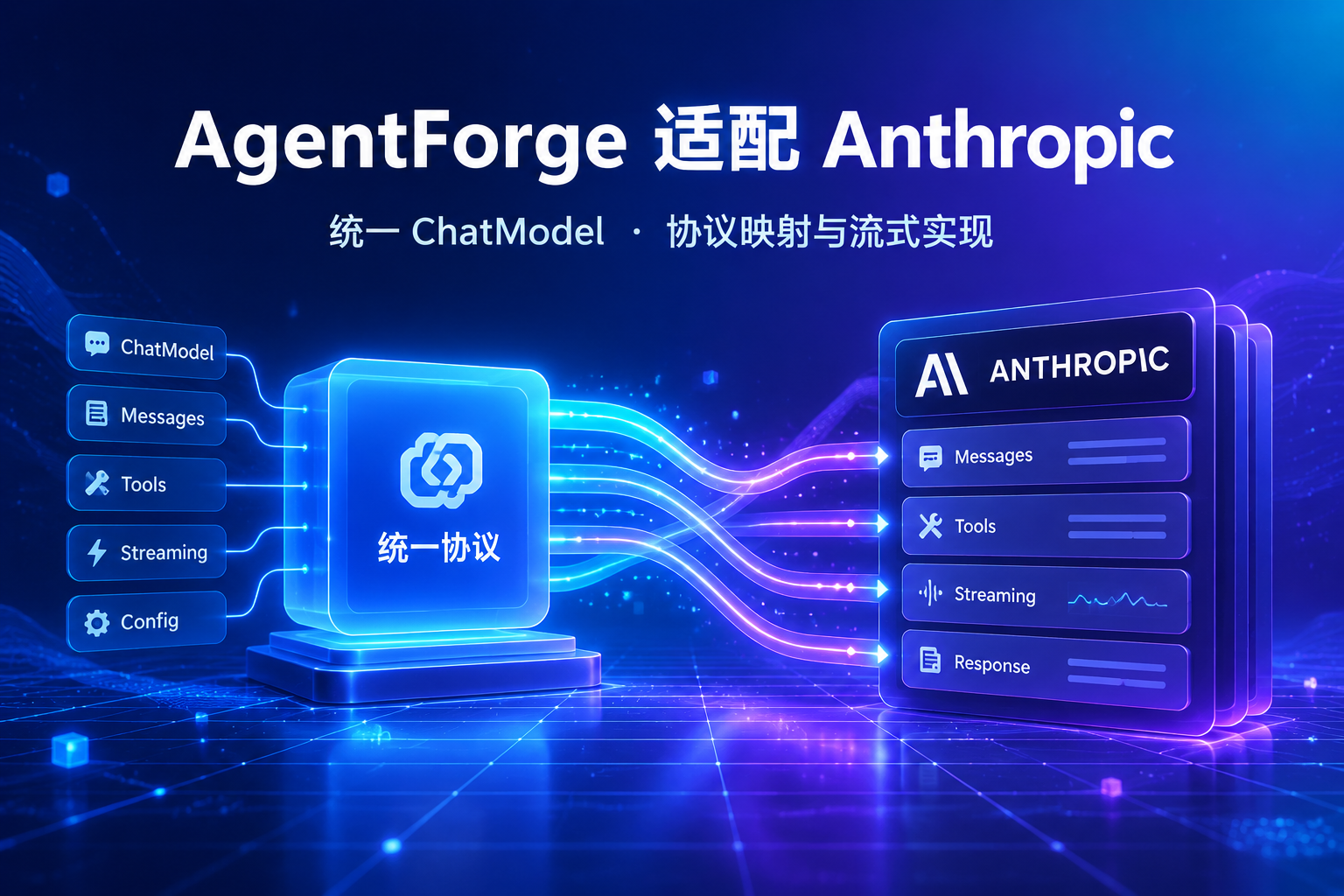
本系列《AgentForge 核心模块设计原理》沿着这条自底向上的路径,逐个模块拆解它的设计原理与实现细节。本文聚焦 AgentForge 适配 Anthropic 的接入实践(统一 ChatRequest / ChatResponse 与 Messages API 的双向映射),对应模块 agentforge-model-anthropic。
- 开源仓库(GitHub):https://github.com/changluya/AgentForge
- 项目文档站:https://changluya.github.io/AgentForge/
- Gitee 镜像:https://gitee.com/changluJava/agent-forge
- 开源协议:MIT
git clone https://github.com/changluya/AgentForge.git
cd AgentForge
mvn clean install -DskipTests
如果这套「自底向上」的设计对你有帮助,欢迎到 GitHub 给 AgentForge 点一个 Star。
一、背景与问题引入
1.1、场景驱动:一套 Core,适配 Claude 的 block 协议
AgentForge 上层只依赖
ChatMessage/ChatRequest/ChatResponse。接入 Claude 时,不能让"system 顶层字段""content block""tool_use/tool_result"这些 wire 细节泄漏到 Agent Runtime。
因此 Anthropic Provider 的职责是协议翻译层,并让 Blocking 与 Streaming 共用同一套映射逻辑。
1.2、问题引导:block 协议如何落到统一消息?
问题:
SystemMessage怎么落到顶层system?AiMessage的 text 与工具调用怎么落到content[]?ToolExecutionResultMessage怎么落到tool_result?流式input_json_delta怎么聚合成完整工具参数?
本文逐项给出映射与实现位置。
1.3、Builder 参数
| Builder 参数 | 默认值 | 说明 |
|---|---|---|
baseUrl |
https://api.anthropic.com |
API 根地址 |
apiKey |
null |
必填,写入 x-api-key |
anthropicVersion |
2023-06-01 |
写入 anthropic-version Header |
modelName |
null |
请求前必须有值 |
temperature |
null |
非空映射 temperature(兼容性见 5.4) |
maxTokens |
1024 |
映射必填的 max_tokens |
topP |
null |
非空映射 top_p(兼容性见 5.4) |
stopSequences |
null |
映射 stop_sequences |
customParameter |
空 | Provider 顶层扩展字段 |
customHeader |
空 | 自定义 Header |
httpTransport |
JdkHttpTransport |
HTTP SPI |
connectTimeoutMillis |
10000 |
连接超时 |
readTimeoutMillis |
60000 |
读取超时 |
重点:
max_tokens是 Anthropic 的必填字段,AgentForge 默认 1024,保证最简单调用可直接执行。
二、核心概念
ChatRequest { List<ChatMessage> messages; ChatRequestParameters parameters; }

ChatResponse { AiMessage aiMessage; TokenUsage tokenUsage; FinishReason finishReason; Map<String,Object> metadata; }
Provider 负责把 Core 的 ChatRequest 翻译为 Anthropic wire,再把响应归一化为 ChatResponse。
三、实现思路与映射
3.1、HTTP Headers
Content-Type: application/json
Accept: application/json
x-api-key: ${ANTHROPIC_API_KEY}
anthropic-version: 2023-06-01
之后追加 customHeaders。
注意:不是
Authorization: Bearer,且必须显式发送anthropic-version。
3.2、SystemMessage 映射
Anthropic 的 system prompt 使用顶层 system 字段。AgentForge 遍历所有 SystemMessage:
SystemMessage A + SystemMessage B → "A\n\nB" → {"system":"A\n\nB"}
拼接后的 system 不再进入 messages 数组。
3.3、User / AI 消息映射
| AgentForge | Anthropic role | content |
|---|---|---|
UserMessage(单文本) |
user |
message.text()(字符串) |
UserMessage(多 Content) |
user |
content[],逐条 TextContent → {"type":"text","text":...} |
AiMessage(纯文本) |
assistant |
message.text()(字符串) |
AiMessage(含工具调用) |
assistant |
content[]:可选 text 块 + tool_use 块 |
ToolExecutionResultMessage |
user |
content[]:tool_result 块 |
SystemMessage |
不进入 messages | 聚合到顶层 system |
3.4、工具调用映射
AiMessage.hasToolExecutionRequests() 为真时,映射为 assistant 的 content[]:
{ "role": "assistant", "content": [
  { "type": "text", "text": "I will check." },
  { "type": "tool_use", "id": "toolu_1", "name": "get_weather", "input": { "city": "hangzhou" } }
]}
ToolExecutionResultMessage 映射为 user 的 content[]:
{ "role": "user", "content": [
  { "type": "tool_result", "tool_use_id": "toolu_1", "content": "{\"temperature\":22}" }
]}
| Core 字段 | Anthropic 字段 |
|---|---|
ToolExecutionRequest.id |
tool_use.id(回填对应 tool_result.tool_use_id) |
ToolExecutionRequest.name |
tool_use.name |
ToolExecutionRequest.arguments(JSON 字符串) |
tool_use.input(解析为对象后下发) |
AiMessage.text |
可选的前置 text 块 |
ToolExecutionResultMessage.isError == true |
tool_result.is_error = true |
注意:
CustomMessage没有text(),当前仍会抛UnsupportedOperationException。
3.5、参数映射
| AgentForge 参数 | Anthropic 字段 | 当前行为 |
|---|---|---|
modelName |
model |
必填;为空本地失败 |
maxTokens |
max_tokens |
必填;默认 1024 |
temperature |
temperature |
非空发送;新模型兼容性需注意 |
topP |
top_p |
非空发送;新模型兼容性需注意 |
stopSequences |
stop_sequences |
非空发送 |
tools |
tools[] |
{"name","description","input_schema"};无参数时下发空 object schema |
toolChoice |
tool_choice |
AUTO→{"type":"auto"}、NONE→{"type":"none"}、REQUIRED→{"type":"any"}、SPECIFIC→{"type":"tool","name":X} |
SystemMessage |
system |
多条以双换行拼接 |
customParameters |
顶层透传 | 标准字段最终覆盖同名 custom 值 |
3.6、响应提取规则
遍历 content 数组:
- 只提取
type == "text"的块,按顺序拼接为AiMessage.text(); - 提取
type == "tool_use"的块,映射为ToolExecutionRequest:
Anthropic tool_use |
AgentForge |
|---|---|
id |
id |
name |
name |
input(对象) |
arguments(Json.stringify(input)) |
content = [text("I will check."), tool_use(...)]
        ↓
AiMessage.text()                     = "I will check."
AiMessage.hasToolExecutionRequests() = true
AiMessage.toolExecutionRequests()    = [ToolExecutionRequest(toolu_1, get_weather, {"city":"hangzhou"})]
注意:只有
tool_use没有 text 块时,AiMessage.text()为null;thinking/image/document/ server tool block 当前不进入AiMessage。
3.7、ChatResponse 映射
| Anthropic 字段 | AgentForge 字段 |
|---|---|
content[*].text |
ChatResponse.aiMessage().text() |
content[*].tool_use |
ChatResponse.aiMessage().toolExecutionRequests() |
usage.input_tokens |
TokenUsage.inputTokens() |
usage.output_tokens |
TokenUsage.outputTokens() |
input + output |
TokenUsage.totalTokens() |
stop_reason |
ChatResponse.finishReason() |
id / model / type |
metadata["id"] / ["model"] / ["type"] |
3.8、stop_reason 映射
| Anthropic | AgentForge FinishReason |
|---|---|
end_turn |
STOP |
stop_sequence |
STOP |
max_tokens |
LENGTH |
tool_use |
TOOL_EXECUTION |
| 其他非空 | OTHER |
null |
null |
3.9、流式实现
AnthropicStreamingChatModel 使用同一 Endpoint,强制 stream=true,Accept: text/event-stream;请求体映射与 Blocking 完全一致,统一由 AnthropicProtocol 生成。
JdkHttpTransport 只按行回调,不解析 SSE 语义;AnthropicStreamState 自行按 event: / data: 累积一帧,遇空行(或单行 data: 帧)时 dispatch:
| 事件 | AgentForge 行为 |
|---|---|
message_start |
记录 metadata["id"]/["model"],读 usage.input_tokens |
content_block_start |
tool_use 时按 index 建累加器,记 id / name / 初始 input |
content_block_delta |
text_delta 立即 onPartialResponse(...);input_json_delta 追加到同 index 工具参数 |
content_block_stop |
不处理,等整块结束 |
message_delta |
读 delta.stop_reason 与 usage.output_tokens |
message_stop |
由 EOF / 完成回调触发最终响应 |
error |
包装为 ModelException 并 onError(...) |
工具调用聚合规则:
- 文本块与工具块可交错出现,互不影响;
arguments按到达顺序拼接原始 JSON 文本,不重新格式化;- 若只有
content_block_start没有input_json_delta(input直接给对象),使用 start 帧的input; - 无任何
partial_json时,arguments归一化为{}; - 与 LangChain4j 一致:流式中不暴露半成品工具调用,只在最终
ChatResponse给出完整结果。
重点:
temperature/top_p已被 Anthropic 官方标记为对较新模型 deprecated/受限;推荐默认不显式设置,按目标模型能力决定是否传入。Provider 后续可加入 model capability 校验,提前在客户端阻止无效参数。
四、实战代码
4.1、非流式
AnthropicChatModel model =
        AnthropicChatModel.builder()
                .baseUrl("https://api.anthropic.com")
                .apiKey(System.getenv("ANTHROPIC_API_KEY"))
                .modelName("your-claude-model")
                .maxTokens(1024)
                .build();

ChatRequest request =
        ChatRequest.builder()
                .message(SystemMessage.from("You are a concise Java assistant."))
                .message(UserMessage.from("Explain volatile."))
                .build();

ChatResponse response = model.chat(request);
System.out.println(response.aiMessage().text());
运行输出(模拟终端)
$ curl -s https://api.anthropic.com/v1/messages -H "x-api-key: $ANTHROPIC_API_KEY" \
    -H "anthropic-version: 2023-06-01" \
    -d '{"model":"your-claude-model","max_tokens":1024,"system":"You are a concise Java assistant.","messages":[{"role":"user","content":"Explain volatile."}]}'

{"id":"msg_xxx","type":"message","role":"assistant",
 "content":[{"type":"text","text":"volatile provides visibility guarantees..."}],
 "stop_reason":"end_turn","usage":{"input_tokens":24,"output_tokens":40}}
4.2、工具调用闭环(wire 示例)
// assistant 发起
{"role":"assistant","content":[
  {"type":"text","text":"I will check."},
  {"type":"tool_use","id":"toolu_1","name":"get_weather","input":{"city":"hangzhou"}}]}

// 工具结果回填
{"role":"user","content":[
  {"type":"tool_result","tool_use_id":"toolu_1","content":"{\"temperature\":22}"}]}
五、错误处理、限制与演进
5.1、本地参数校验
modelName 必须非空
apiKey 必须非空
messages 中至少有一条非 system 的 user/assistant 类消息
只有 SystemMessage 时抛:
IllegalArgumentException: Anthropic request requires at least one user/assistant message
5.2、HTTP 错误
非 2xx → new ModelException("Anthropic request failed with HTTP " + statusCode, statusCode, responseBody);IOException → ModelException("Anthropic request failed", cause)。上层可统一读取 exception.statusCode() / exception.responseBody()。
5.3、当前未实现能力
已落地:Streaming/SSE、tool_use 强类型响应(含流式 input_json_delta 聚合)、tool_result 强类型请求、tools/tool_choice 请求映射、UserMessage 多 Content → content[]。
尚未完整支持:thinking / redacted thinking、image / document content blocks、Prompt Caching 强类型配置与 usage、Structured Output、server tools、extended usage 字段(cache token 等)、stop_sequence 写入 metadata、provider refusal / stop details 标准化。
5.4、类结构与演进
Blocking 与 Streaming 共用同一套 wire mapping:
AnthropicProtocol(package-private)
    ├── collectSystemMessages / serializeMessages
    ├── serializeTools / toolChoice
    ├── extractText / extractToolUses
        │
        ├── AnthropicChatModel          -> blocking Messages API
        └── AnthropicStreamingChatModel -> Messages API SSE
后续引入 Thinking / Multimodal 时,建议在 Core 扩展统一 Content 层级(TextContent 已存在):ImageContent / AudioContent / VideoContent / PdfFileContent,使 Anthropic block protocol 与 OpenAI 多模态汇聚到同一上层模型。
六、总结
- 两大差异:
system顶层字段、contentblock 数组——都被 Provider 层吸收,Core 不变。 - 工具调用:
tool_use(input对象)→tool_result(user角色回填),强类型双向映射。 - 流式:
AnthropicStreamState自行解析带事件名的 SSE,input_json_delta按 blockindex聚合。 - 必填约束:
max_tokens默认 1024,保证直接可调用。 - 风险提示:新 Claude 模型对
temperature/top_p收紧,默认不设置更安全。
参考资料
[1]. Anthropic Messages API(英文)
[2]. Anthropic Messages API(中文)
整理者:长路 创建时间:2026.10.5 更新时间:2026.10.5
评论区请在客户端页面查看